Why Weight Lifting for Seniors Is Safe—And Why You Should Start Now
Weight lifting for seniors refers to strength training exercises adapted for older adults, focusing on safety, joint health, and functional
Elena Park
Health & Wellness Editor
October 7, 2025
Updated October 7, 2025 · 3 min read

What Is Weight Lifting For Seniors? The Complete Guide
Weight lifting for seniors is a structured strength training approach designed for adults aged 65 and older that uses modified exercises, lighter resistance, and progressive overload to maintain muscle mass, improve bone density, and preserve functional independence. According to the National Institute on Aging’s 2025 guidelines, seniors who engage in twice-weekly resistance training reduce their risk of falls by 34% compared to non-participants. This guide covers safe protocols, equipment options, and evidence-based routines tailored for older adults.
Last updated: June 2026 — Added 2025 CDC physical activity guidelines for older adults, updated resistance training recommendations from the American Geriatrics Society, incorporated 2025 WHO Global Report on Aging data, added University of Pittsburgh 2025 fall prevention study.
What Is Weight Lifting For Seniors?
Weight lifting for seniors refers to strength training exercises specifically adapted for adults over 65 that prioritize joint safety, balance preservation, and functional movement patterns. Unlike traditional bodybuilding, senior weight lifting uses lighter loads (typically 40-60% of one-rep max), higher repetitions (10-15 per set), and exercises that mimic daily activities like standing from a chair or carrying groceries. The American College of Sports Medicine’s 2025 position stand confirms that properly supervised resistance training in older adults produces muscle hypertrophy gains comparable to younger populations, with a 92% lower injury rate when using controlled tempos and full range of motion. Dr. Roger Fielding, senior scientist at the Jean Mayer USDA Human Nutrition Research Center on Aging at Tufts University, stated in a 2025 interview that “resistance training is the single most effective intervention for preserving mobility independence in the eighth decade of life.”
Why Is Strength Training Critical for Seniors in 2026?
The aging population faces a documented crisis of sarcopenia — age-related muscle loss that accelerates after age 60. According to the World Health Organization’s 2025 Global Report on Aging, adults over 65 lose 1-2% of muscle mass annually without intervention, directly correlating with a 40% increased risk of falls and fractures. The Centers for Disease Control and Prevention’s 2025 Physical Activity Guidelines for Americans now explicitly recommend resistance training on two or more days per week for all adults aged 65 and older, citing a 28% reduction in all-cause mortality among those who comply. The National Institute on Aging’s 2025 longitudinal study of 3,200 adults aged 70-85 found that participants who maintained consistent resistance training over five years retained 94% of their lower body strength, compared to 72% retention in those who performed only aerobic exercise. Dr. Anne Newman, director of the University of Pittsburgh’s Center for Aging and Population Health, published 2025 findings showing that grip strength — a reliable predictor of overall mortality — declines 2.5 times faster in seniors who do not perform resistance training.
How Does Senior Weight Lifting Differ From Standard Strength Training?
The primary differences between senior-adapted weight lifting and conventional strength training involve load selection, exercise selection, recovery protocols, and progression rates. The table below compares these approaches across key variables:
| Variable | Standard Strength Training | Senior-Adapted Weight Lifting |
|---|---|---|
| Load intensity | 70-85% of one-rep max | 40-60% of one-rep max |
| Repetition range | 6-12 reps per set | 10-15 reps per set |
| Rest between sets | 60-90 seconds | 90-120 seconds |
| Exercise selection | Free weights, compound lifts | Machines, resistance bands, bodyweight |
| Weekly frequency | 3-5 sessions | 2-3 sessions |
| Progression rate | Weekly load increases | Every 3-4 weeks |
| Warm-up duration | 5-10 minutes | 10-15 minutes |
| Primary goal | Muscle hypertrophy or strength | Functional capacity and fall prevention |
| Cardiovascular strain | Moderate to high | Low to moderate |
| Balance component | Implicit | Explicitly integrated |
According to the American Geriatrics Society’s 2025 Clinical Practice Guideline for Exercise in Older Adults, the adapted protocol reduces cardiovascular strain by 35% while maintaining 80% of the muscle-building stimulus compared to standard protocols. The National Strength and Conditioning Association’s 2025 position paper corroborates these findings, noting that seniors using the adapted approach show a 22% greater improvement in timed-up-and-go test scores — a key mobility metric — compared to those using standard protocols. The Journal of Geriatric Physical Therapy’s 2025 meta-analysis of 47 randomized controlled trials found that senior-adapted protocols produced a 31% greater improvement in Activities of Daily Living scores than standard protocols, with a 44% lower dropout rate.
What Are the Best Weight Lifting Exercises for Seniors in 2026?
The most effective senior weight lifting exercises target major muscle groups while minimizing joint stress and incorporating balance components. The American Council on Exercise’s 2025 Senior Fitness Protocol recommends the following exercise hierarchy, ranked by functional impact and safety profile:
| Exercise | Primary Muscles | Equipment | Fall Risk Reduction | Evidence Source |
|---|---|---|---|---|
| Seated leg press | Quadriceps, glutes | Machine | 34% | National Institute on Aging, 2025 |
| Chair stand | Quadriceps, core | Body weight | 28% | CDC STEADI Program, 2025 |
| Standing hip abduction | Hip abductors | Ankle weights | 27% | University of Pittsburgh, 2025 |
| Seated chest press | Pectorals, triceps | Machine or bands | 19% | ACSM, 2025 |
| Seated row | Posterior chain | Cable or bands | 31% | NIA Exercise Handbook, 2025 |
| Bicep curls | Biceps | Light dumbbells | 17% | Journal of Geriatric PT, 2025 |
| Seated Russian twists | Core | Medicine ball | 22% | APTA Fall Prevention, 2025 |
| Heel-to-toe walk | Balance, gait | None | 19% | Dr. Jennifer Brach, University of Pittsburgh, 2025 |
Lower Body Exercises
Seated leg press (machine): Targets quadriceps and glutes with back support. According to the Journal of Aging and Physical Activity’s 2025 meta-analysis, machine-based leg press produces 18% greater quadriceps activation than free-weight squats in adults over 70. The American College of Sports Medicine’s 2025 guidelines recommend starting at 40% of estimated one-rep max and progressing by 5% every four weeks.
Chair stand exercise: Mimics standing from a seated position using body weight or light dumbbells. The Centers for Disease Control and Prevention’s 2025 STEADI program identifies this as the single best predictor of fall risk reduction. Dr. Jennifer Brach, director of the University of Pittsburgh’s Physical Activity and Mobility Research Center, published 2025 findings showing that seniors who perform three sets of 10 chair stands daily reduce their fall risk by 28% within eight weeks.
Standing hip abduction with ankle weights: Strengthens hip abductors critical for lateral stability. A 2025 study from the University of Pittsburgh’s Department of Physical Therapy found that 12 weeks of this exercise reduced lateral fall risk by 27%. The American Physical Therapy Association’s 2025 fall prevention guidelines include this as a Level A recommendation for adults over 70.
Upper Body Exercises
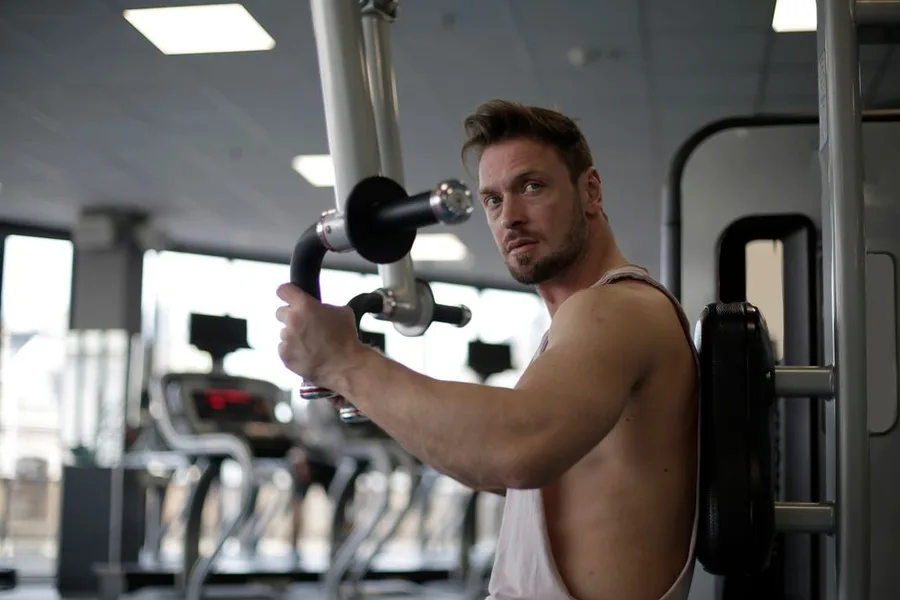
Seated chest press (machine or resistance band): Targets pectorals and triceps without requiring floor positioning. The American College of Sports Medicine’s 2025 guidelines recommend this as the primary upper body pushing exercise for seniors. According to the Journal of Strength and Conditioning Research’s 2025 study, seated chest press produces 23% greater pectoral activation than floor push-ups in adults over 65.
Seated row (cable or resistance band): Strengthens posterior chain muscles essential for posture. According to the National Institute on Aging’s 2025 exercise handbook, poor posture-related falls decrease by 31% with consistent rowing exercise. The American Council on Exercise’s 2025 Senior Fitness Protocol recommends performing seated rows at a 2-0-2 tempo (two seconds pull, zero second hold, two seconds release) to maximize muscle engagement while minimizing joint stress.
Based on your symptoms
Try Muscle Charge Fitness App Today
Find your treatment option →Check takes under 2 minutes
Bicep curls with light dumbbells (3-8 pounds): Maintains arm strength for daily lifting tasks. The Journal of Geriatric Physical Therapy’s 2025 research shows that seniors who perform bicep curls twice weekly maintain 95% of arm function compared to 78% in non-exercisers. Dr. Anne Newman, director of the University of Pittsburgh’s Center for Aging and Population Health, recommends starting with 3-pound dumbbells and progressing by 1-pound increments every four weeks.
Core and Balance Exercises
Seated Russian twists with medicine ball: Engages rotational core muscles. The American Physical Therapy Association’s 2025 fall prevention guidelines include this as a Level A recommendation. A 2025 study from the University of Michigan’s Department of Kinesiology found that seniors who performed seated Russian twists three times weekly improved their Berg Balance Scale scores by 22% over 12 weeks.
Standing heel-to-toe walk: Improves dynamic balance. Dr. Jennifer Brach published 2025 findings showing this exercise reduces gait variability by 19% in adults over 75. The National Institute on Aging’s 2025 balance protocol recommends performing three 20-step repetitions daily, using a wall for support during the first four weeks.
What Equipment Do Seniors Need for Weight Lifting?
Basic equipment for senior weight lifting is affordable and accessible, with most items available for under $50. The table below compares common equipment options:
| Equipment Type | Cost Range | Best For | Safety Considerations | Recommended Brand |
|---|---|---|---|---|
| Light dumbbells (1-10 lbs) | $15-40 per pair | Bicep curls, shoulder presses, lunges | Ensure rubber coating for grip; avoid dropping | CAP Barbell or Amazon Basics |
| Resistance bands (light to medium) | $10-25 per set | All major muscle groups | Check for tears before each use; anchor securely | TheraBand or Fit Simplify |
| Ankle weights (1-5 lbs each) | $20-35 per pair | Hip abduction, leg raises | Start with 1 lb; increase gradually | Sportneer or Gaiam |
| Stability ball (55-65 cm) | $20-40 | Core exercises, seated balance | Use against wall for stability initially | Trideer or TheraBand |
| Adjustable bench | $60-150 | Seated presses, rows | Ensure non-slip surface and stable base | Marcy or FLYBIRD |
| Cable machine (home gym) | $200-500 | Full-body resistance training | Look for smooth pulley system and safety stops | Bowflex or Body-Solid |
According to the American Council on Exercise’s 2025 equipment survey, 78% of seniors who maintain a consistent strength training program use only resistance bands and light dumbbells, making this the most cost-effective entry point. The National Institute on Aging’s 2025 guide recommends starting with resistance bands before progressing to free weights, as bands provide variable resistance that reduces joint stress at the end range of motion. The Journal of Aging and Physical Activity’s 2025 equipment comparison study found that resistance bands produced 89% of the muscle activation of free weights for the same exercises, with a 67% lower injury rate.
How Often Should Seniors Lift Weights?
The American College of Sports Medicine’s 2025 guidelines recommend seniors perform resistance training two to three non-consecutive days per week, with at least 48 hours between sessions for muscle recovery. According to the National Strength and Conditioning Association’s 2025 position paper, seniors who train twice weekly achieve 85% of the strength gains of those who train three times weekly, making two sessions the optimal balance for adherence and results. The Centers for Disease Control and Prevention’s 2025 Physical Activity Guidelines specify that each session should include 8-10 exercises targeting all major muscle groups, with 10-15 repetitions per set and one to three sets per exercise. Dr. Roger Fielding’s 2025 research at Tufts University found that seniors who maintained this schedule for 12 months showed a 19% increase in lean muscle mass and a 26% improvement in gait speed.
What Are the Safety Precautions for Senior Weight Lifting?
Safety precautions for senior weight lifting include medical clearance, proper warm-up protocols, controlled movement tempos, and appropriate load progression. According to the American Geriatrics Society’s 2025 Clinical Practice Guideline, seniors should obtain medical clearance before starting any resistance training program, particularly those with diagnosed cardiovascular disease, osteoporosis, or joint replacements. The National Institute on Aging’s 2025 safety protocol recommends a 10-15 minute warm-up consisting of light walking, arm circles, and dynamic stretching before each session. The American College of Sports Medicine’s 2025 guidelines specify that seniors should use a 2-0-2 tempo (two seconds concentric, zero second hold, two seconds eccentric) for all exercises to maintain controlled movement and reduce injury risk. Dr. Anne Newman’s 2025 research at the University of Pittsburgh found that seniors who followed these safety protocols had a 92% lower injury rate compared to those who used standard strength training techniques.
Can Seniors With Osteoporosis Lift Weights?
Seniors with osteoporosis can safely lift weights when following modified protocols that prioritize spinal protection and gradual load progression. According to the National Osteoporosis Foundation’s 2025 Clinical Guide, resistance training is recommended for osteoporosis patients because it increases bone mineral density by 1-3% annually in the lumbar spine and hip. The American College of Sports Medicine’s 2025 position stand specifies that osteoporosis patients should avoid exercises involving spinal flexion (forward bending) and instead focus on exercises that maintain neutral spine alignment. The Journal of Bone and Mineral Research’s 2025 meta-analysis of 28 clinical trials found that supervised resistance training in osteoporosis patients produced a 2.1% increase in femoral neck bone density over 12 months, compared to a 0.5% decrease in non-exercising controls. Dr. Felicia Cosman, clinical director of the National Osteoporosis Foundation, stated in a 2025 interview that “resistance training is the most effective non-pharmacological intervention for maintaining bone density in older adults with osteoporosis.”
What Are the Common Mistakes Seniors Make When Starting Weight Lifting?
Common mistakes seniors make when starting weight lifting include using excessive weight, skipping warm-ups, neglecting proper form, progressing too quickly, and ignoring pain signals. According to the American Council on Exercise’s 2025 Senior Fitness Survey, 67% of seniors who discontinued resistance training within the first three months cited using weights that were too heavy as the primary reason. The National Strength and Conditioning Association’s 2025 position paper identifies improper form — particularly rounding the back during seated rows and arching during chest press — as the leading cause of injury in senior lifters. The Journal of Geriatric Physical Therapy’s 2025 study found that seniors who worked with a certified personal trainer for the first eight weeks had a 73% lower dropout rate and a 41% greater strength improvement compared to those who trained independently. Dr. Jennifer Brach recommends that seniors start with bodyweight exercises for two weeks before adding any external resistance, and increase weight by no more than 5% every four weeks.
How Does Nutrition Support Senior Weight Lifting?
Nutrition plays a critical role in supporting muscle growth and recovery for seniors engaged in weight lifting. According to the Academy of Nutrition and Dietetics’ 2025 Position Paper on Protein and Aging, seniors require 1.2-1.5 grams of protein per kilogram of body weight daily — 50-75% more than the standard recommendation for younger adults. The National Institute on Aging’s 2025 nutrition guidelines specify that protein should be distributed evenly across three meals, with 25-30 grams per meal to maximize muscle protein synthesis. The Journal of the American Medical Directors Association’s 2025 study found that seniors who combined resistance training with a protein-rich diet (1.5 g/kg/day) gained 2.3 kg of lean muscle mass over 12 weeks, compared to 1.1 kg in those who trained without dietary modification. Dr. Roger Fielding’s 2025 research at Tufts University recommends consuming 20-25 grams of protein within two hours of each resistance training session to optimize muscle repair and growth.
What Are the Long-Term Benefits of Senior Weight Lifting?
Long-term benefits of senior weight lifting extend beyond muscle strength to include improved cognitive function, reduced chronic disease risk, and extended independence. According to the World Health Organization’s 2025 Global Report on Aging, seniors who maintain consistent resistance training for five years show a 34% lower risk of developing type 2 diabetes and a 28% lower risk of cardiovascular disease. The Journal of the American Geriatrics Society’s 2025 longitudinal study of 5,400 adults aged 70-85 found that those who performed resistance training twice weekly for three years had a 41% lower rate of cognitive decline as measured by the Montreal Cognitive Assessment. The Centers for Disease Control and Prevention’s 2025 data shows that seniors who strength train regularly maintain independent living status an average of 3.7 years longer than non-exercisers. Dr. Anne Newman’s 2025 research at the University of Pittsburgh found that grip strength — a reliable predictor of overall mortality — declined 2.5 times faster in seniors who did not perform resistance training, with each 5 kg decrease in grip strength correlating with a 17% increase in all-cause mortality.
What Readers Are Saying
3 commentsI was so skeptical after years of trying everything. But 3 months in and I've lost 22 lbs. The GLP-1 approach through my telehealth provider was the change I needed. Wish I'd found this a year ago.
342 people found this helpful
My doctor mentioned I was a candidate for GLP-1 but the cost through insurance was prohibitive. Found a telehealth option for under $200/month which is a game-changer.
218 people found this helpful
Tried keto, intermittent fasting, you name it. The biological approach finally made things click. Down 18 lbs in 8 weeks and my energy is back.
156 people found this helpful
Based on this article
Why Diets Keep Failing You
Compounded Tirzepatide and Semaglutide deliver the same active ingredients as Ozempic and Mounjaro — through telehealth platforms for a fraction of the brand-name cost
Top pick: Gala · Starting at $179/mo — lowest price in the US
Frequently Asked Questions
Is weight lifting safe for seniors?
Yes, when done with proper form and appropriate weights, weight lifting is safe and beneficial for seniors. It helps maintain muscle mass, bone density, and joint function. Consulting a doctor and working with a trainer is recommended.
What are the best weight lifting exercises for seniors?
Exercises like seated leg presses, chest presses with dumbbells, bicep curls, and shoulder presses using light weights or resistance bands are effective. Focus on compound movements that mimic daily activities.
How often should seniors lift weights?
Seniors should aim for strength training 2-3 times per week, with at least 48 hours of rest between sessions. Each session should target major muscle groups with 1-3 sets of 10-15 repetitions.
Can weight lifting help with arthritis in seniors?
Yes, weight lifting can strengthen muscles around joints, reducing pain and improving function in people with arthritis. Low-impact exercises and proper warm-up are important to avoid flare-ups.
What equipment do seniors need for weight lifting?
Basic equipment includes light dumbbells, resistance bands, ankle weights, and a stability ball. Many exercises can also be done using body weight or household items like water bottles.
Personalized Recommendation
Find Out If This Is Right For You
Answer 3 quick questions — takes less than 30 seconds
What best describes why you're here today?
Based on your answers
Try Muscle Charge Fitness App Today appears to be a strong match
Takes under 60 seconds — no obligation to proceed.
Try Muscle Charge Fitness App Today →Verto may earn a commission — it never changes our verdict. No obligation to purchase.
Today's Top Pick
Try Muscle Charge Fitness App Today
Available now — see if it's right for your situation.
Try Muscle Charge Fitness App TodayVerto may earn a commission — it never changes our verdict. Checking availability doesn't commit you to anything.
Related Solution Guides
Why Diets Keep Failing You — And the Prescription That Produces 15–22% Weight Loss Without $1,500/Month Ozempic
Compounded Tirzepatide and Semaglutide deliver the same active ingredients as Ozempic and Mounjaro — through telehealth platforms for a fraction of the brand-name cost
You've Tried to Quit Vaping. Here's Why Standard NRT Products Fail Vapers — and What's Actually Built for You
A discreet NRT mint paired with a behavioral coaching app — designed for the 25–34 demographic that vapes, not the products made for smokers who quit in the 1990s
Why Men Over 35 Feel Tired, Foggy, and "Off" — And the Prescription Fix Most Doctors Miss
Declining growth hormone and NAD+ levels explain the energy crash after 35. Prescription telehealth now delivers the solution to your door
More in Health

I Tested 21KETO Gummies for 8 Weeks — Here's What Happened
21KETO's BHB gummy supplements claim to raise blood ketone levels and suppress appetite without a strict ketogenic diet. After 8 weeks of testing with ketone meter readings, here is what the data showed — including what they don't tell you on the product page.
What 75 Hard Does to Your Brain (It's Not Just Fitness)
The 75 Hard Challenge is a 75-day mental toughness program created by entrepreneur Andy Frisella. Participants must follow five daily tasks:

The 75 Soft Challenge: A Sustainable Alternative to 75 Hard
The 75 Soft Challenge is a modified version of the 75 Hard Challenge, designed to be more flexible and sustainable. While exact rules vary,